

Field Gas Conditioning for Frac Fleets: How Plum Gas Solutions Unlocks On-Site Natural Gas
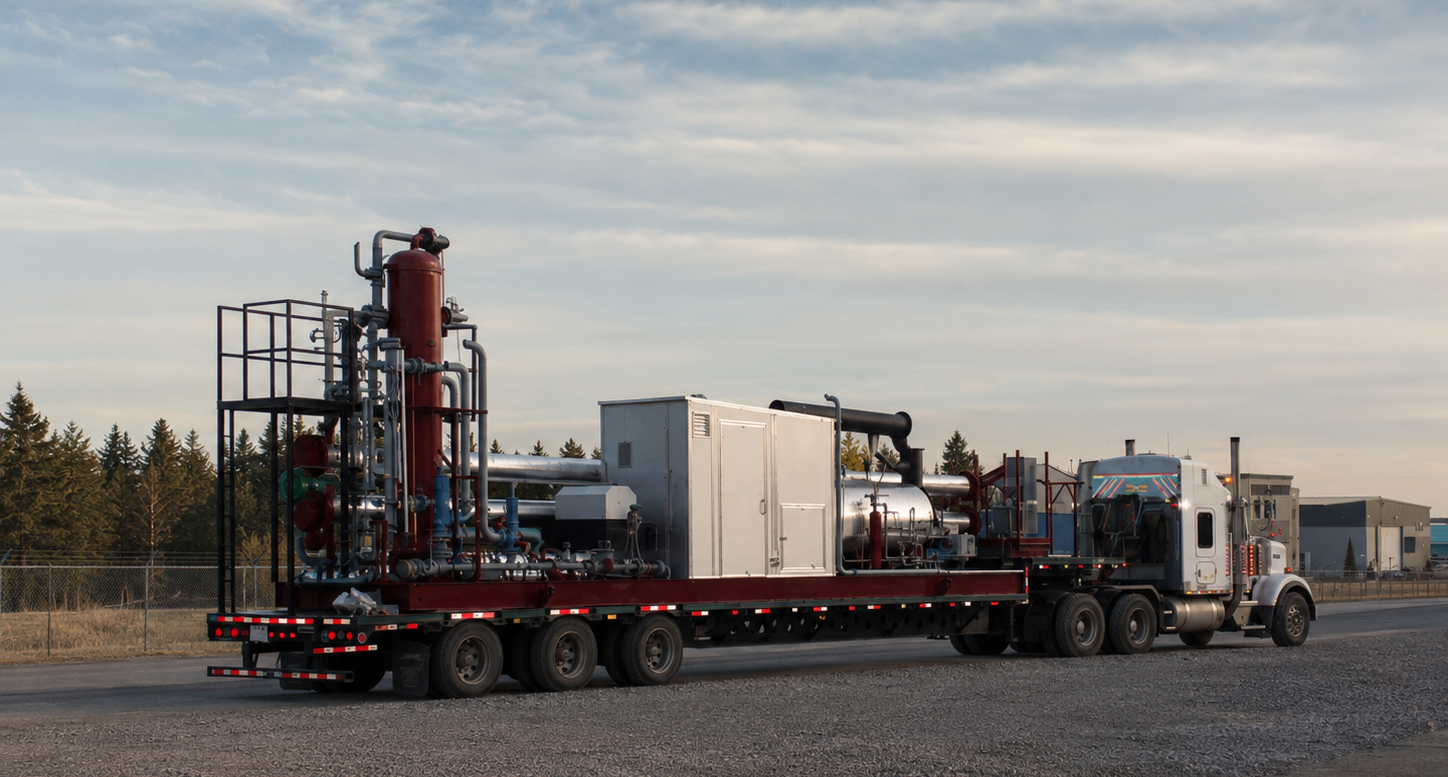
At many well pads, associated gas is already flowing through midstream infrastructure during production. However, this gas is not immediately usable as fuel. It often contains heavier hydrocarbons (C3+), liquids, and impurities that must be removed or stabilized before it can be safely used in engines or turbines.
Without conditioning, operators are forced to fare or underutilize available gas, continue relying on diesel or delivered CNG, absorb unnecessary fuel costs and logistics complexity
Plum Gas Solutions enables field gas conditioning to support frac fleets and high-demand operations. By converting raw associated gas into fuel-quality natural gas, Plum helps operators reduce diesel dependence, lower costs, and improve operational efficiency—without relying solely on delivered fuel.
The Problem: Diesel and Delivered Fuel at Scale
Frac fleets and high-load operations consume massive volumes of fuel. Traditionally, this has meant diesel, which requires continuous truck deliveries and on-site storage.
Even when operators shift to CNG, fuel still must be transported to the site, logistics and emissions remain a factor, and costs can remain elevated.
At scale, both models introduce inefficiencies.
Why Field Gas Conditioning Matters
Field gas conditioning allows operators to use the gas already available at the site—transforming it into a clean, consistent fuel source.
Conditioned field gas enables high diesel substitution rates and improves trucking fuel logistics. It also lowers emissions and environmental impact while significantly reduces fuel costs compared to diesel or delivered gas.
This approach represents one of the most efficient paths to decarbonization in oilfield operations.
How Plum Gas Solutions Delivers Field Gas Conditioning
Plum Gas Solutions integrates field gas conditioning into a broader, fully engineered natural gas delivery system.
Step 1: Evaluate Gas Supply and Demand
Plum first assesses field gas composition and variability, required pressure and flow rates, fleet fuel demand and duty cycles, site infrastructure and constraints.
Step 2: Condition Gas to Fuel Quality
Using modular, deployable systems, Plum removes heavy hydrocarbons and liquids, stabilizes gas composition, and produces lean, consistent fuel gas suitable for engines and turbines
Conditioning ensures the gas meets operational requirements and avoids performance issues such as engine damage or inconsistent combustion.
Step 3: Deliver and Regulate Gas on Site
Plum integrates conditioning with pressure reduction systems (PRS) for controlled delivery, compression and flow management systems, and custom manifolds and distribution infrastructure.
This ensures the conditioned gas is delivered at the exact specifications required for frac fleets or power generation.
Step 4: Monitor and Optimize Performance
All systems are supported by SCADA-enabled telemetry, real-time monitoring of pressure, flow, and temperature, and remote diagnostics and system optimization.
This allows for consistent performance even as gas composition and demand fluctuate.
Key Benefits of Plum’s Field Gas Conditioning Approach
Maximize Diesel Displacement
By converting raw field gas into usable fuel, operators can achieve significantly higher diesel substitution rates, reducing reliance on transported fuels.
Reduce Fuel Costs
Field gas is often available at a fraction of the cost of diesel or delivered CNG, creating immediate economic benefits.
Eliminate Logistics Constraints
Using on-site gas reduces truck traffic, delivery scheduling challenges, and supply chain risk
Improve Environmental Performance
Lower CO₂ and particulate emissions, reduced trucking emissions, and less flaring of associated gas.
Enable Scalable Operations
Plum’s modular systems are trailer-mounted and mobile, rapidly deployable across sites, and capable of supporting high-volume demand.
Systems can adapt to changing gas supply and operational requirements, ensuring continuous fuel availability.
Field Gas Conditioning in Practice
In real-world applications, field gas conditioning systems can accept raw gas directly from midstream or wellhead connections and process and deliver consistent, high-quality fuel gas. This supports continuous operation of dual-fuel or electric frac fleets
Advanced systems are capable of rapid deployment (often within 24–48 hours), autonomous operation with minimal field oversight, and high throughput to meet demanding frac schedules.
Why Plum Gas Solutions
Plum Gas Solutions provides more than just equipment—it delivers a fully integrated energy solution.
Key differentiators:
- End-to-end system design and execution
- Integration of field gas conditioning + virtual pipeline delivery
- Expertise in PRS, compression, and gas management systems
- Rapid deployment and field-ready infrastructure
- Real-time monitoring and operational support
Plum ensures customers have access to the right fuel, at the right quality, at the right time—anywhere.
Conclusion: Turning Field Gas into a Strategic Advantage
Field gas conditioning transforms a traditionally underutilized resource into a reliable, cost-effective fuel solution.
As operators look to reduce diesel use and improve efficiency, Plum Gas Solutions provides a scalable pathway forward—combining on-site gas conditioning, engineered delivery systems, and real-time operational control.
The result is a smarter energy model, with lower cost, lower emissions, and greater operational reliability.