
What It Takes to Power the Next Generation of Data Centers
Data center power demand is growing faster than the grid can keep up. In some markets, connecting a new data center to the grid can take seven to 10 years.
That gap is pushing more developers to generate power on site. Fifty-nine planned U.S. data centers, representing roughly 90 gigawatts of capacity, intend to use behind-the-meter generation. Most of those projects were announced in just the past two years.
The most common fuel source for this onsite generation is natural gas. Plum Gas Solutions provides the infrastructure that makes natural gas a highly reliable fuel source by conditioning and delivering it at the exact pressure, temperature, and quality required by turbines to generate electricity.
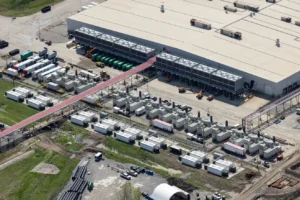 Plum has played a pioneering role in bringing behind-the-meter power online at some of the country’s earliest and largest data center projects, including xAI’s record-scale Colossus 1 data center in Tennessee.
We spoke with Kehau Kincaid, Chief Operating Officer at Plum Gas Solutions, about the growing demand for onsite generation and how Plum helps make natural gas-fired power reliable at scale.
What brought Plum into the data center market?
Data centers have been around for decades, but the sector changed with generative AI. Everyone started to understand how much compute power would be necessary to train and run large language models.
So, the commercial market you see today, with all its demand and scale, is still very new. We’re only talking about the last couple of years.
Plum was introduced to data centers in 2024, through a customer developing mobile microgrids for one of the first and largest hyperscale buildouts in the country. Existing power infrastructure couldn’t handle the load required to operate on the developer’s timeline. That’s where we came in. We were told, essentially, “We need your equipment on site in four weeks.”
Our role was to supply the data center’s turbines with a consistent source of natural gas, at the specific temperature and pressure they needed to operate efficiently. Plum’s success on that project became our entry into this market.
What does it take to keep onsite power generation running reliably at data centers?
Most people understand the enormous scale of these projects. We’re talking about gigawatts of power, comparable to the power demand of a city. To meet that demand, you may have 20 to 40 individual turbines on a site. Those turbines can’t operate efficiently and reliably without a consistent source of natural gas.
What’s less understood is that the gas has to arrive within very specific ranges of temperature and pressure, without liquids or other contaminants reaching the power equipment.
Those specifications—the gas quality—are critical to keeping the turbines performing over the life of a project. If the gas falls outside the optimal range, it can damage components and shorten the life of the equipment.
What happens when gas is inconsistent or poorly conditioned?
Turbines are multimillion-dollar pieces of equipment. You may be planning around a rebuild every four years. If a turbine has been operating on poorly conditioned gas and needs an overhaul after only two years, you often have to take it completely out of service.
That means major costs and potentially significant disruption for the data center.
So, operators are looking for every way they can to keep that equipment performing reliably, and that’s Plum’s specialty. The infrastructure we provide conditions and delivers natural gas consistently, at the optimal specifications the turbines require.
We’re one part of a very large power system, but a critical one.
What differentiates Plum’s equipment in an environment where reliability is so important?
I’d point to three things.
First is precision at scale. We can control gas temperature and pressure within a very specific range while operating at an enormous scale. Right now, we’re bringing that precision to more than 15 power generation sites, including over five hyperscale data centers. We’re very proud of that.
Second is speed. This market moves incredibly fast. On one of the country’s largest data center projects, we helped deploy the natural gas infrastructure required to fuel more than 25 turbines and bring the project online in under three months. Working with developers to deliver at that pace is something Plum is exceptionally good at.
The third is simplicity. We design our equipment around the operator, with modular design, clear instrumentation, and intuitive telemetry. The system layout is practical and serviceable, so operators can understand, operate, and troubleshoot the equipment confidently in the field.
To learn more about Plum Gas Solutions and how we can support your next data center project, get in touch with our team.